Кубические осцилляции
7/10Через центр неподвижного куба со стороной \(a\), равномерно заряженного по объёму с плотностью заряда \(\rho\), проходит узкий прямолинейный канал. Расстояние от центра куба до пересечения канала с гранями равно \(L\). В канале находится частица с массой \(m\) и зарядом \(q\).
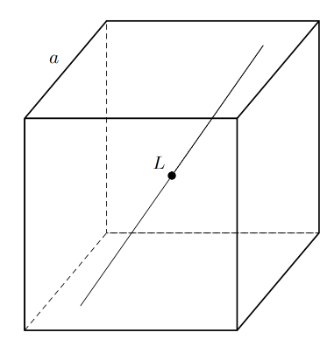
A1. Найдите период малых колебаний частицы вблизи центра. Гравитационным взаимодействием частицы и куба можно пренебречь. Заряды куба и частицы разноимённые.
▶Показать разборСкрыть разбор
РешениеA1. We will use a coordinate system with axes parallel to the cube’s edges, with the origin set at the cube’s center. Assuming the particle is at coordinates \((x, y, z)\) \(x\ll a\), \(y\ll a\), \(z\ll a\), we will find the force \(\vec{F}\) acting on the particle, by splitting the cube \(a\times a\times a\) into a rectangular cuboid \((a - 2x)\times (a - 2y)\times (a - 2z)\) and three square plates of thickness \(2x\), \(2y\) and \(2z\).
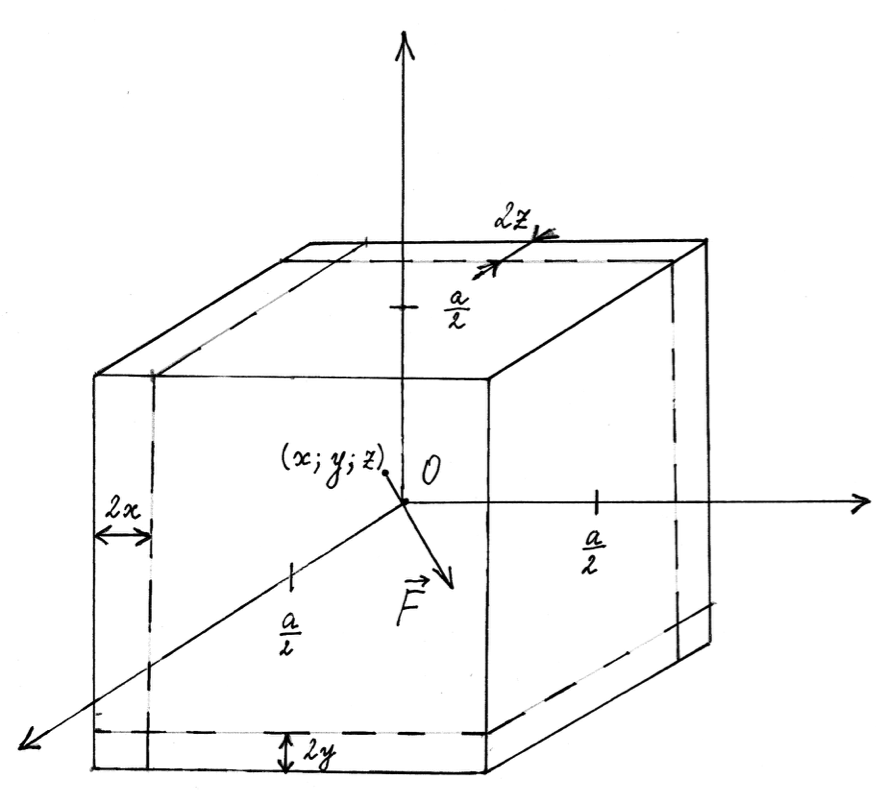
The particle is in the center of the cuboid, so there is no force from the cuboid.
Let us find the force between a particle with a charge \(q\) and a uniformly charged square plate of small thickness \(h\) and edge length \(a\). The plate’s charge density is \(\rho\), the particle is placed above the center of the plate at distance \(a/2\).
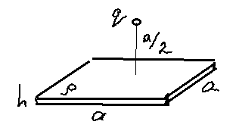
Due to symmetry and Gauss’s law, the flux of the particle’s electric field through the plate is
\[\Phi = \frac{q}{6\varepsilon_0}.\]Hence, the force
\[F = \sigma\Phi = \frac{q\rho h}{6\varepsilon_0},\]where \(\sigma = \rho h\) is plate’s surface charge density.
Three square plates act on the particle with forces \(\vec{F_1} = \frac{q\rho x}{3\varepsilon_0}\hat{x}\), \(\vec{F_2} = \frac{q\rho y}{3\varepsilon_0}\hat{y}\), and \(\vec{F_3} = \frac{q\rho z}{3\varepsilon_0}\hat{z}\). Net force \(\vec{F} = \vec{F_1} + \vec{F_2} + \vec{F_3} = \frac{q\rho}{3\varepsilon_0}\vec{r},\) where \(\vec{r}\) is the position vector of the particle.
The particle’s equation of motion
\[m\vec{\ddot{r}} = \frac{q\rho}{3\varepsilon_0}\vec{r}\]is an equation of simple harmonic motion with period
Ответ:
\[T = 2\pi\sqrt{\frac{3m\varepsilon_0}{q(-\rho)}}.\]
Перевод: pho.rs.
Похожие задачи
- Шар на натянутой струне Савченко, №3.1.1
- Груз на пружине Савченко, №3.1.2
- Жёсткость из амплитуды и скорости Савченко, №3.1.3
- Лампочка «вспыхивает» в крайних точках Савченко, №3.1.4
- Математический маятник Савченко, №3.1.5
- Максимальная скорость маятника Савченко, №3.1.6