Частицы от Солнца
5/10Фотоны, излучаемые с поверхности Солнца и нейтрино из его ядра несут нам информацию о температурах Солнца, а также могут подтвердить, что Солнце светит благодаря ядерным реакциям.
Во всех пунктах этой задачи примите массу Солнца \(M_\odot = 2.00 \cdot 10^{30}~кг\), его радиус \(R_\odot = 7.00 \cdot 10^8~м\), его мощность (энергия, излученная в единицу времени) \(L_\odot = 3.85 \cdot 10^{26}~Вт\), и расстояние от Земли до Солнца \(d_\odot = 1.50 \cdot 10^{11}~м\).
Примечание.\[\begin{gathered}\int x e^{a x} \,\mathrm d x=\left(\frac{x}{a}-\frac{1}{a^2}\right) e^{a x}+\operatorname{const}\\\int x^2 e^{a x} \,\mathrm d x=\left(\frac{x^2}{a}-\frac{2 x}{a^2}+\frac{2}{a^3}\right) e^{a x}+\operatorname{const}\\\int x^3 e^{a x} \,\mathrm d x=\left(\frac{x^3}{a}-\frac{3 x^2}{a^2}+\frac{6 x}{a^3}-\frac{6}{a^4}\right) e^{a x}+\operatorname{const}\end{gathered}\]
Часть А. Излучение Солнца (5 баллов)
A1. Полагая, что Солнце излучает как абсолютно черное тело, вычислите температуру \(T_S\) поверхности Солнца.
Спектр солнечного излучения можно с хорошей точностью приблизить распределением Вина. Соответственно, солнечная энергия, приходящая в единицу времени в единичном диапазоне частот на некоторую площадку на Земле, зависит от частоты так: \[u(\nu)=A \frac{R_{\odot}^2}{d_{\odot}^2} \frac{2 \pi h}{c^2} \nu^3 \exp \left(-h \nu / k_{\mathrm{B}} T_S\right)\] где \(\nu\) – это частота и \(A\) – площадь поверхности этой площадки, нормальной к направлению падающего излучения.
Рассмотрим солнечный элемент, который представляет собой тонкий диск из полупроводникового материала. Площадь диска – \(A\). Солнечный элемент расположен перпендикулярно направлению падения солнечных лучей.
A2. Используя приближение Вина, выразите полную мощность солнечного излучения \(P_\mathrm{in}\), падающего на поверхность солнечного элемента, через \(A\), \(R_\odot\), \(d_\odot\), \(T_S\) и фундаментальные константы \(c\), \(h\), \(k_B\).
A3. Как зависит от частоты число фотонов \(n_\gamma(\nu)\), падающих в единицу времени в единичном диапазоне частот на поверхность солнечного элемента? Выразите ответ через \(A\), \(R_\odot\), \(d_\odot\), \(T_S\), \(\nu\) и фундаментальные константы \(c\), \(h\), \(k_B\).
У полупроводника, из которого изготовлен солнечный элемент, ширина запрещенной зоны \(E_g\). Используйте следующую модель. Каждый фотон с энергией \(E\ge E_g\) позволяет электрону преодолеть запрещенную зону. Возбужденный электрон может преобразовать в полезную только энергию \(E_g\), остальная часть энергии рассеивается в виде тепла (не может быть преобразована в полезную).
A4. Считайте, что \(\chi_g = h\nu_g/k_BT_S\), где \(E_g = h\nu_g\). Выразите полезную мощность солнечного элемента \(P_\mathrm{out}\) через \(\chi_g\), \(A\), \(R_\odot\), \(d_\odot\), \(T_S\) и фундаментальные константы \(c\), \(h\), \(k_B\).
A5. Выразите КПД солнечного элемента \(\eta\) через \(\chi_g\).
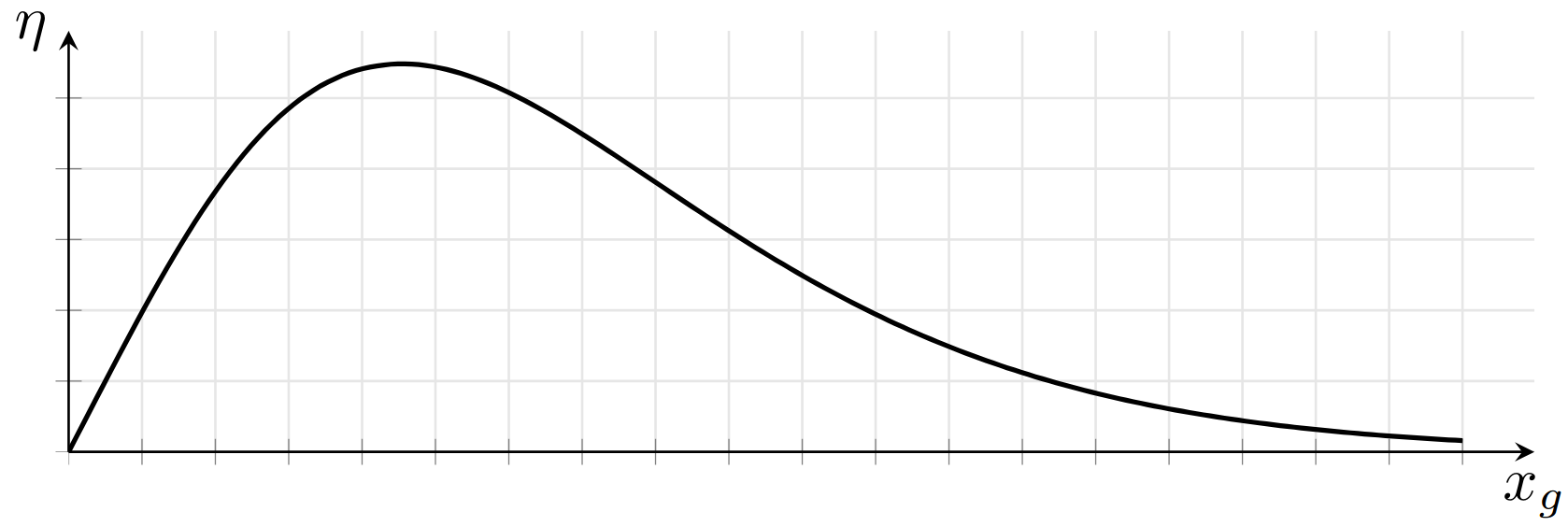
A6. Нарисуйте качественный график зависимости \(\eta\) от \(\chi_g\). Явно укажите значения \(\eta\) при \(\chi_g = 0\) и \(\chi_g\to\infty\). Чему равен угловой коэффициент касательной к графику \(\eta(\chi_g)\) при \(\chi_g = 0\) и \(\chi_g\to\infty\)?
A7. Пусть \(\chi_0\) — это такое значение \(\chi_g\), при котором \(\eta\) максимален. Получите кубическое уравнение, для которого \(\chi_0\) будет решением. Оцените численное значение \(\chi_0\) с точностью \(\pm0.25\). Рассчитайте также \(\eta(\chi_0)\).
A8. Ширина запрещенной зоны чистого кремния \(E_g = 1.11~эВ\). Рассчитайте КПД кремниевого солнечного элемента \(\eta_\mathrm{Si}\), используя это значение.
В конце XIX века Кельвин и Гельмгольц для объяснения излучения Солнца предложили гипотезу. Они постулировали, что вначале Солнце было очень большим облаком материи массы \(M_\odot\) и пренебрежимо малой плотности. Затем Солнце постоянно сжималось. Таким образом, Солнце могло бы светить, постоянно теряя гравитационную потенциальную энергию из-за своего медленного сжатия.
A9. Предположим, что плотность вещества внутри Солнца всюду одинакова. Найдите полную гравитационную потенциальную энергию Солнца \(\Omega\), которой оно обладает в наши дни. Выразите ее через \(G\), \(M_\odot\) и \(R_\odot\).
A10. Считая, что мощность излучения Солнца оставалась постоянной на протяжении всего времени, оцените максимально возможное время \(\tau_\mathrm{KH}\) (в годах), на протяжении которого Солнце могло светить согласно гипотезе Кельвина и Гельмгольца.
Значение \(\tau_\mathrm{KH}\), рассчитанное выше, не согласуется с возрастом солнечной системы, который был оценен при изучении метеоритов. Это говорит о том, что источником энергии Солнца не может быть только гравитационная энергия.
Часть B. Нейтрино от Солнца (5 баллов)
В 1938 Ганс Бете предположил, что ядерная реакция синтеза гелия из водорода, происходящая в ядре Солнца, – это его источник энергии. Результирующее уравнение ядерной реакции:
\[4{}^1\mathrm{H} \rightarrow {}^4\mathrm{He}+2 \mathrm{e}^{+}+2 \nu_{\mathrm{e}}\]Электронные нейтрино \(\nu_e\), которые получаются в этой реакции, можно считать безмассовыми. Они вылетают из Солнца и их обнаружение на Земле подтверждает то, что внутри Солнца происходят ядерные реакции. Во всех пунктах этой задачи вы можете пренебречь энергией, уносимой нейтрино.
B1. Рассчитайте плотность потока нейтрино \(Ф_\nu\) (в \(м^{-2}с^{-1}\)), которые достигают Земли. Энергия, которая выделяется в реакции приведенной выше \(\Delta E = 4.0 \cdot 10^{-12}~Дж\). Считайте, что энергия, излучаемая Солнцем, полностью получается в реакции приведенной выше.
На пути из ядра Солнца к Земле часть электронных нейтрино \(\nu_e\) превращается в нейтрино других типов \(\nu_x\). Эффективность детектирования \(\nu_x\) составляет \(1/6\) эффективности детектирования \(\nu_e\). Если бы не происходило превращения нейтрино, мы бы в среднем детектировали \(N_1\) нейтрино в год. Однако, из-за этих превращений в среднем детектируется \(N_2\) нейтрино в год (\(\nu_e\) и \(\nu_x\) вместе).
B2. Какая доля \(f\) частиц \(\nu_e\) превращается в \(\nu_x\)? Выразите ответ через \(N_1\) и \(N_2\).
Чтобы детектировать нейтрино, построены огромные детекторы, наполненные водой. Хотя взаимодействия нейтрино с веществом крайне редки, иногда они выбивают электроны из молекул воды в детекторе. Эти высокоэнергетические электроны летят в воде с большими скоростями и при этом излучают свет. До тех пор, пока скорость электрона больше скорости света в воде (показатель преломления \(n\)), это излучение, называемое Черенковским излучением, испускается в виде конуса.
B3. Предположим, что при движении в воде электрон, выбитый нейтрино, теряет энергию с постоянной скоростью \(a\) в единицу времени. Найдите энергию, переданную электрону \(E_\mathrm{imparted}\) от нейтрино, считая, что после соударения такой электрон испускает Черенковское излучение на протяжении времени \(\Delta t\). Перед соударением электрон покоился. Выразите ответ через \(\Delta t\), \(n\), \(m_e\) и \(c\).
Синтез гелия He из водорода H внутри Солнца происходит в несколько этапов. На одном из промежуточных этапов образуется ядро бериллия \(^7\mathrm{Be}\) (масса покоя \(m_\mathrm{Be}\)). Оно может поглотить электрон и образовать ядро лития \(^7\mathrm{Li}\) (масса покоя \(m_\mathrm{Li} < m_\mathrm{Be}\)), испустив \(\nu_e\). Соответствующая реакция такая:\[^7\mathrm{Be} + e^-~\to~ ^7\mathrm{Li} + \nu_e\]Когда покоящееся ядро бериллия \(\mathrm{Be}\) \((m_\mathrm{Be} = 11.65\cdot 10^{-27}~кг)\) поглощает покоящийся электрон, испускаемое нейтрино уносит энергию \(E_\nu = 1.44\cdot 10^{-13}~Дж\). Однако, ядра бериллия находятся в постоянном тепловом движении при температуре \(T_c\) ядра Солнца и представляют собой движущиеся источники нейтрино. В результате, энергия испущенных нейтрино варьируется в среднем на \(\Delta E_\mathrm{rms}\) (среднеквадратичное отклонение).
B4. Принимая \(\Delta E_\mathrm{rms}=5.54\cdot 10^{-17}~Дж\), рассчитайте среднеквадратичную скорость теплового движения ядер бериллия \(V_\mathrm{Be}\) и затем оцените температуру \(T_c\) ядра Солнца.
Подсказка. \(\Delta E_\mathrm{rms}\) зависит от среднеквадратичного значения проекции скорости на направление, вдоль которого ведется наблюдение.
▶Показать разборСкрыть разбор
ОтветA1: \[T_{\mathrm{s}}=\left(\frac{L_{\odot}}{4 \pi R_{\odot}^{2} \sigma}\right)^{1 / 4}=5.76 \cdot 10^{3} \mathrm{~K}\]; A2: \[P_{\text {in }}=\frac{12 \pi k_{\mathrm{B}}^{4}}{c^{2} h^{3}} T_{\mathrm{s}}^{4} A \frac{R_{\odot}^{2}}{d_{\odot}^{2}}\]; A3: \[n_{\gamma}(\nu) =A \frac{R_{\odot}^{2}}{d_{\odot}^{2}} \frac{2 \pi}{c^{2}} \nu^{2} \exp \left(-h \nu / k_{\mathrm{B}} T_{\mathrm{s}}\right)\]; A4: \[P_{\mathrm{out}}=\frac{2 \pi k_{\mathrm{B}}^{4}}{c^{2} h^{3}} T_{\mathrm{s}}^{4} A \frac{R_{\odot}^{2}}{d_{\odot}^{2}} x_{\mathrm{g}}\left(x_{\mathrm{g}}^{2}+2 x_{\mathrm{g}}+2\right) e^{-x_{\mathrm{g}}}\]; A7: \[\eta(2.27)=0.457\]; A8: \[\eta_{\mathrm{Si}}=0.457\]; A9: \[\Omega=-\frac{3}{5} \frac{G M_{\odot}^{2}}{R_{\odot}}\]; A10: \[\tau_{\mathrm{KH}}=1.88 \cdot 10^{7}~ \mathrm{years}\]; B2: \[f=\frac{6}{5}\left(1-\frac{N_{2}}{N_{1}}\right)\]; B3: \[E_{\text {imparted }}=\alpha \Delta t+\left(\frac{n}{\sqrt{n^{2}-1}}-1\right) m_{\mathrm{e}} c^{2}\]
РешениеA1. Stefan's law: \(L_{\odot}=\left(4 \pi R_{\odot}^{2}\right)\left(\sigma T_{\mathrm{s}}^{4}\right)\)\[T_{\mathrm{s}}=\left(\frac{L_{\odot}}{4 \pi R_{\odot}^{2} \sigma}\right)^{1 / 4}=5.76 \cdot 10^{3} \mathrm{~K}\]The spectrum of solar radiation can be approximated well by the Wien distribution law. Accordingly, the solar energy incident on any surface on the Earth per unit time per unit frequency interval, \(u(\nu)\), is given by\[u(\nu)=A \frac{R_{\odot}^{2}}{d_{\odot}^{2}} \frac{2 \pi h}{c^{2}} \nu^{3} \exp \left(-h \nu / k_{\mathrm{B}} T_{\mathrm{s}}\right),\]where \(A\) is the area of the surface normal to the direction of the incident radiation.
Now, consider a solar cell which consists of a thin disc of semiconducting material of area, \(A\), placed perpendicular to the direction of the Sun's rays.
Ответ:
\[T_{\mathrm{s}}=\left(\frac{L_{\odot}}{4 \pi R_{\odot}^{2} \sigma}\right)^{1 / 4}=5.76 \cdot 10^{3} \mathrm{~K}\]
A2. \[P_{\mathrm{in}}=\int_{0}^{\infty} u(\nu) d \nu=\int_{0}^{\infty} A \frac{R_{\odot}^{2}}{d_{\odot}^{2}} \frac{2 \pi h}{c^{2}} \nu^{3} \exp \left(-h \nu / k_{\mathrm{B}} T_{\mathrm{s}}\right) d \nu\] Let \(x=\dfrac{h \nu}{k_{\mathrm{B}} T_{\mathrm{s}}}\). Then, \(\nu=\dfrac{k_{\mathrm{B}} T_{\mathrm{s}}}{h} x \quad d \nu=\dfrac{k_{\mathrm{B}} T_{\mathrm{s}}}{h} d x\). \[P_{\text {in }}=\frac{2 \pi h A R_{\odot}^{2}}{c^{2} d_{\odot}^{2}} \frac{\left(k_{\mathrm{B}} T_{\mathrm{s}}\right)^{4}}{h^{4}} \int_{0}^{\infty} x^{3} e^{-x} d x=\frac{2 \pi k_{\mathrm{B}}^{4}}{c^{2} h^{3}} T_{\mathrm{s}}^{4} A \frac{R_{\odot}^{2}}{d_{\odot}^{2}} \cdot 6=\frac{12 \pi k_{\mathrm{B}}^{4}}{c^{2} h^{3}} T_{\mathrm{s}}^{4} A \frac{R_{\odot}^{2}}{d_{\odot}^{2}}\]
Ответ:
\[P_{\text {in }}=\frac{12 \pi k_{\mathrm{B}}^{4}}{c^{2} h^{3}} T_{\mathrm{s}}^{4} A \frac{R_{\odot}^{2}}{d_{\odot}^{2}}\]
A3. \[\begin{aligned} n_{\gamma}(\nu) & =\frac{u(\nu)}{h \nu} \\ & =A \frac{R_{\odot}^{2}}{d_{\odot}^{2}} \frac{2 \pi}{c^{2}} \nu^{2} \exp \left(-h \nu / k_{\mathrm{B}} T_{\mathrm{s}}\right) \end{aligned}\] The semiconducting material of the solar cell has a "band gap" of energy, \(E_{\mathrm{g}}\). We assume the following model. Every photon of energy \(E \geq E_{\mathrm{g}}\) excites an electron across the band gap. This electron contributes an energy, \(E_{\mathrm{g}}\), as the useful output energy, and any extra energy is dissipated as heat (not converted to useful energy).
Ответ:
\[n_{\gamma}(\nu) =A \frac{R_{\odot}^{2}}{d_{\odot}^{2}} \frac{2 \pi}{c^{2}} \nu^{2} \exp \left(-h \nu / k_{\mathrm{B}} T_{\mathrm{s}}\right)\]
A4. The useful power output is the useful energy quantum per photon, \(E_{\mathrm{g}} \equiv h \nu_{\mathrm{g}}\), multiplied by the number of photons with energy, \(E \geq E_{\mathrm{g}}\).\[\begin{aligned} P_{\mathrm{out}} & =h \nu_{\mathrm{g}} \int_{\nu_{\mathrm{g}}}^{\infty} n_{\gamma}(\nu) d \nu \\ & =h \nu_{\mathrm{g}} A \frac{R_{\odot}^{2}}{d_{\odot}^{2}} \frac{2 \pi}{c^{2}} \int_{\nu_{\mathrm{g}}}^{\infty} \nu^{2} \exp \left(-h \nu / k_{\mathrm{B}} T_{\mathrm{s}}\right) d \nu \\ & =k_{\mathrm{B}} T_{\mathrm{s}} x_{\mathrm{g}} A \frac{R_{\odot}^{2}}{d_{\odot}^{2}} \frac{2 \pi}{c^{2}}\left(\frac{k_{\mathrm{B}} T_{\mathrm{s}}}{h}\right)^{3} \int_{x_{\mathrm{g}}}^{\infty} x^{2} e^{-x} d x \\ & =\frac{2 \pi k_{\mathrm{B}}^{4}}{c^{2} h^{3}} T_{\mathrm{s}}^{4} A \frac{R_{\odot}^{2}}{d_{\odot}^{2}} x_{\mathrm{g}}\left(x_{\mathrm{g}}^{2}+2 x_{\mathrm{g}}+2\right) e^{-x_{\mathrm{g}}} \end{aligned}\]
Ответ:
\[P_{\mathrm{out}}=\frac{2 \pi k_{\mathrm{B}}^{4}}{c^{2} h^{3}} T_{\mathrm{s}}^{4} A \frac{R_{\odot}^{2}}{d_{\odot}^{2}} x_{\mathrm{g}}\left(x_{\mathrm{g}}^{2}+2 x_{\mathrm{g}}+2\right) e^{-x_{\mathrm{g}}}\]
A5. Efficiency \(\eta=\dfrac{P_{\text {out }}}{P_{\text {in }}}=\dfrac{x_{\mathrm{g}}}{6}\left(x_{\mathrm{g}}^{2}+2 x_{\mathrm{g}}+2\right) e^{-x_{\mathrm{g}}}\)
\[\eta=\dfrac{x_{\mathrm{g}}}{6}\left(x_{\mathrm{g}}^{2}+2 x_{\mathrm{g}}+2\right) e^{-x_{\mathrm{g}}}\]
A6. \[\eta=\frac{1}{6}\left(x_{\mathrm{g}}^{3}+2 x_{\mathrm{g}}^{2}+2 x_{\mathrm{g}}\right) e^{-x_{\mathrm{g}}}\]Put limiting values, \(\eta(0)=0 \quad \eta(\infty)=0\).\ Since the polynomial has all positive coefficients, it increases monotonically; the exponential function decreases monotonically. Therefore, \(\eta\) has only one maximum.\[\begin{aligned} & \frac{\mathrm{d} \eta}{\mathrm{~d} x_{\mathrm{g}}}=\frac{1}{6}\left(-x_{\mathrm{g}}^{3}+x_{\mathrm{g}}^{2}+2 x_{\mathrm{g}}+2\right) e^{-x_{\mathrm{g}}} \\ & \left.\frac{\mathrm{~d} \eta}{\mathrm{~d} x_{\mathrm{g}}}\right|_{x_{\mathrm{g}}=0}=\left.\frac{1}{3} \quad \frac{\mathrm{~d} \eta}{\mathrm{~d} x_{\mathrm{g}}}\right|_{x_{\mathrm{g}} \rightarrow \infty}=0 \end{aligned}\]
Ответ:
A7. The maximum will be for \(\dfrac{\mathrm{d} \eta}{\mathrm{d} x_{\mathrm{g}}}=\dfrac{1}{6}\left(-x_{\mathrm{g}}^{3}+x_{\mathrm{g}}^{2}+2 x_{\mathrm{g}}+2\right) e^{-x_{\mathrm{g}}}=0\) \[\Rightarrow p\left(x_{\mathrm{g}}\right) \equiv x_{\mathrm{g}}^{3}-x_{\mathrm{g}}^{2}-2 x_{\mathrm{g}}-2=0\]A Numerical Solution by the Bisection Method:
\(x_\mathrm{g}\) \(p\) 0 -2 1 -4 2 -2 2.25 -0.171 2.5 2.375 3 10 \[2.25~{<}~x_{0}~{<}~2.5\]The approximate value of \(x_{\mathrm{g}}\) where \(\eta\) is maximum is \(x_{0}=2.27\). Alternative methods leading to the same result are acceptable.
Ответ:
\[\eta(2.27)=0.457\]
A8. \[\begin{gathered} x_{\mathrm{g}}=\dfrac{1.11 \cdot 1.60 \cdot 10^{-19}}{1.38 \cdot 10^{-23} \cdot 5763}=2.23 \\ \eta_{\mathrm{Si}}=\dfrac{x_{\mathrm{g}}}{6}\left(x_{\mathrm{g}}^{2}+2 x_{\mathrm{g}}+2\right) e^{-x_{\mathrm{g}}}=0.457 \end{gathered}\]
In the late nineteenth century, Kelvin and Helmholtz (KH) proposed a hypothesis to explain how the Sun shines. They postulated that starting as a very large cloud of matter of mass, \(M_{\odot}\), and negligible density, the Sun has been shrinking continuously. The shining of the Sun would then be due to the release of gravitational energy through this slow contraction.
Ответ:
\[\eta_{\mathrm{Si}}=0.457\]
A9. The total gravitational potential energy of the Sun: \[\Omega=-\int_{0}^{M_{\odot}} \frac{G m \mathrm{~d} m}{r}\] For constant density, \(\rho=\dfrac{3 M_{\odot}}{4 \pi R_{\odot}^{3}}, ~m=\frac{4}{3} \pi r^{3} \rho, ~\mathrm{~d} m=4 \pi r^{2} \rho \mathrm{~d} r\) \[\Omega=-\int_{0}^{R_{\odot}} G\left(\frac{4}{3} \pi r^{3} \rho\right)\left(4 \pi r^{2} \rho\right) \frac{\mathrm{d} r}{r}=-\frac{16 \pi^{2} G \rho^{2}}{3} \frac{R_{\odot}^{5}}{5}=-\frac{3}{5} \frac{G M_{\odot}^{2}}{R_{\odot}}\]
Ответ:
\[\Omega=-\frac{3}{5} \frac{G M_{\odot}^{2}}{R_{\odot}}\]
A10. \[\begin{gathered} \tau_{\mathrm{KH}}=\frac{-\Omega}{L_{\odot}} \\ \tau_{\mathrm{KH}}=\frac{3 G M_{\odot}^{2}}{5 R_{\odot} L_{\odot}}=1.88 \cdot 10^{7} ~\mathrm{years} \end{gathered}\] The \(\tau_{\mathrm{KH}}\) calculated above does not match the age of the solar system estimated from studies of meteorites. This shows that the energy source of the Sun cannot be purely gravitational.
Ответ:
\[\tau_{\mathrm{KH}}=1.88 \cdot 10^{7}~ \mathrm{years}\]
B1. \[4.0 \cdot 10^{-12} \mathrm{~J} \leftrightarrow 2 \nu\] \[\Phi_{\nu}=\frac{L_{\odot}}{4 \pi d_{\odot}^{2} \delta E} \cdot 2=\frac{3.85 \cdot 10^{26}}{4 \pi \cdot\left(1.50 \cdot 10^{11}\right)^{2} \cdot 4.0 \cdot 10^{-12}} \cdot2=6.8 \cdot 10^{14} \mathrm{~m}^{-2} \mathrm{~s}^{-1}\] Travelling from the core of the Sun to the Earth, some of the electron neutrinos, \(\nu_{\mathrm{e}}\), are converted to other types of neutrinos, \(\nu_{\mathrm{x}}\). The efficiency of the detector for detecting \(\nu_{\mathrm{x}}\) is \(1 / 6\) th of its efficiency for detecting \(\nu_{\mathrm{e}}\). If there is no neutrino conversion, we expect to detect an average of \(N_{1}\) neutrinos in a year. However, due to the conversion, an average of \(N_{2}\) neutrinos ( \(\nu_{\mathrm{e}}\) and \(\nu_{\mathrm{x}}\) combined) are actually detected per year.
\[\Phi_{\nu}=6.8 \cdot 10^{14} \mathrm{~m}^{-2} \mathrm{~s}^{-1}\]
B2. \[\begin{aligned} & N_{1}=\varepsilon N_{0} \\ & N_{e}=\varepsilon N_{0}(1-f) \\ & N_{x}=\varepsilon N_{0} f / 6 \\ & N_{2}=N_{e}+N_{x} \end{aligned}\] OR \[\begin{aligned} & (1-f) N_{1}+\frac{f}{6} N_{1}=N_{2} \\ & \Rightarrow f=\frac{6}{5}\left(1-\frac{N_{2}}{N_{1}}\right) \end{aligned}\] In order to detect neutrinos, large detectors filled with water are constructed. Although the interactions of neutrinos with matter are very rare, occasionally they knock out electrons from water molecules in the detector. These energetic electrons move through water at high speeds, emitting electromagnetic radiation in the process. As long as the speed of such an electron is greater than the speed of light in water (refractive index, \(n\) ), this radiation, called Cherenkov radiation, is emitted in the shape of a cone.
Ответ:
\[f=\frac{6}{5}\left(1-\frac{N_{2}}{N_{1}}\right)\]
B3. When the electron stops emitting Cherenkov radiation, its speed has reduced to \(v_{\text {stop }}=c / n\). Its total energy at this time is\[E_{\text {stop }}=\frac{m_{\mathrm{e}} c^{2}}{\sqrt{1-v_{\text {stop }}^{2} / c^{2}}}=\frac{n m_{\mathrm{e}} c^{2}}{\sqrt{n^{2}-1}}\]The energy of the electron when it was knocked out is\[E_{\mathrm{start}}=\alpha \Delta t+\frac{n m_{\mathrm{e}} c^{2}}{\sqrt{n^{2}-1}}\]Before interacting, the energy of the electron was equal to \(m_{\mathrm{e}} c^{2}\).
Thus, the energy imparted by the neutrino is\[E_{\text {imparted }}=E_{\text {start }}-m_{\mathrm{e}} c^{2}=\alpha \Delta t+\left(\frac{n}{\sqrt{n^{2}-1}}-1\right) m_{\mathrm{e}} c^{2}\]The fusion of H into He inside the Sun takes place in several steps. Nucleus of \({ }^{7} \mathrm{Be}\) (rest mass, \(m_{\mathrm{Be}}\) ) is produced in one of these intermediate steps. Subsequently, it can absorb an electron, producing a \({ }^{7} \mathrm{Li}\) nucleus (rest mass \(m_{\mathrm{Li}}<m_{\mathrm{Be}}\) ) and emitting a \(\nu_{\mathrm{e}}\). The corresponding nuclear reaction is:\[{ }^{7} \mathrm{Be}+\mathrm{e}^{-} \longrightarrow{ }^{7} \mathrm{Li}+\nu_{\mathrm{e}} .\]When a Be nucleus (\(m_{\mathrm{Be}}=11.65 \cdot 10^{-27} \mathrm{~kg}\)) is at rest and absorbs an electron also at rest, the emitted neutrino has energy \(E_{\nu}=1.44 \cdot10^{-13} \mathrm{~J}\). However, the Be nuclei are in random thermal motion due to the temperature \(T_{\mathrm{c}}\) at the core of the Sun, and act as moving neutrino sources. As a result, the energy of emitted neutrinos fluctuates with a root mean square value \(\Delta E_{\mathrm{rms}}\).
Ответ:
\[E_{\text {imparted }}=\alpha \Delta t+\left(\frac{n}{\sqrt{n^{2}-1}}-1\right) m_{\mathrm{e}} c^{2}\]
B4. Moving \({ }^{7}\mathrm{Be}\) nuclei give rise to Doppler effect for neutrinos. Since the fractional change in energy ( \(\Delta E_{\mathrm{rms}} / E_{\nu} \sim 10^{-4}\) ) is small, the Doppler shift may be considered in the nonrelativistic limit (a relativistic treatment gives almost same answer). Taking the line of sight along the \(z\)-direction, \[\begin{aligned} \frac{\Delta E_{\mathrm{rms}}}{E_{\nu}} & =\dfrac{v_{z, r m s}}{c} \\ & =3.85 \cdot 10^{-4} \\ & =\frac{1}{\sqrt{3}} \dfrac{V_{\mathrm{Be}}}{c} \end{aligned}\] \[\Rightarrow V_{\mathrm{Be}}=\sqrt{3} \cdot3.85 \cdot 10^{-4} \cdot 3.00 \cdot 10^{8} \mathrm{~m} \mathrm{~s}^{-1}=2.01 \cdot 10^{5} \mathrm{~m} \mathrm{~s}^{-1}.\] The average temperature is obtained by equating the average kinetic energy to the thermal energy. \[\begin{aligned} & \frac{1}{2} m_{\mathrm{Be}} V_{\mathrm{Be}}^{2}=\frac{3}{2} k_{\mathrm{B}} T_{\mathrm{c}} \end{aligned}\]
Ответ:
\[T_{\mathrm{c}}=1.13 \cdot 10^{7} \mathrm{~K}\]
Перевод: pho.rs.
Похожие задачи
- Расширяющаяся Вселенная APhO 2015/16, 11 кл.
- Звезда, не выпускающая свет МОШ 1995/96, 10 кл.