Упрощенная модель атомного ядра
6/10Несмотря на то, что атомное ядро – квантовый объект, некоторые закономерности, касающиеся его свойств (таких как радиус и энергия связи), можно вывести из нескольких простых положений:
ядро состоит из нуклонов (протонов и нейтронов);
ядерные силы, связывающие нуклоны в ядре, являются короткодействующими (они действуют только между соседними нуклонами);
количество протонов \((Z)\) в ядре приблизительно равно количеству нейтронов \((N)\), то есть \(Z\approx N\approx A/2\), где \(A\) – общее количество нуклонов (\(A\gg1\)).
Часть A. Атомное ядро как плотно упакованная система нуклонов
Атомное ядро как плотно упакованная система нуклонов. Согласно простейшей модели, ядро можно представить как шар, плотно заполненный нуклонами, которые представляют собой шарики радиуса \(r_N=0.85~фм\) \((1~фм=10^{-15}~м)\). Ядерные силы действуют только при непосредственном контакте двух нуклонов. Объём ядра \(V\) больше суммы объёмов нуклонов \(AV_N\), где \(V_N=\frac43\pi r^3_N\) – объём нуклона. Отношение \(f=AV_N/V\) называется фактором упаковки и представляет собой относительную часть объёма, заполненную ядерным веществом.
A1. Определите фактор упаковки \(f\), если нуклоны упакованы как в простой кубической кристаллической решётке (англ. simple cubic, SC), где каждый нуклон занимает место в вершинах куба (см. рис).
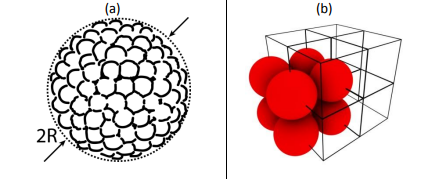
SC-упаковка
Внимание! В каждом последующем задании считайте фактор упаковки атомных ядер равным фактору упаковки, полученному в задании A1. Если вы не смогли его вычислить, в дальнейшем используйте \(f=1/2\).
A2. Оцените среднюю плотность массы \(\rho_m\) плотность заряда \(\rho_q\) и радиус \(R\) ядра, имеющего \(A\) нуклонов. Средняя масса нуклона равна \(1.67\cdot 10^{-27}~ кг\).
Часть B. Энергия связи атомных ядер – объёмные и поверхностные факторы
Энергия связи это энергия, необходимая для разделения ядра на отдельные нуклоны. Если данный нуклон находится внутри ядра, то он вносит в полную энергию связи энергию \(a_V=15.8~МэВ\) \((1~МэВ=1.602\cdot10^{-13}~Дж)\). Вклад одного нуклона, находящегося на поверхности ядра, в общую энергию связи приблизительно равен \(a_V/2\).
B1. Выразите энергию связи ядра \(E_b\), содержащего \(A\) нуклонов, через вели-чины \(A\), \(a_V\) и \(f\). Сделайте поправку на то, что часть нуклонов находится на поверхности ядра.
Часть C. Влияние электростатических (кулоновских) сил на энергию связи
Электростатическая энергия однородно по объему заряженного шара радиуса \(R\) (общий заряд \(Q\)) равна \(U_C=\cfrac{3Q^2_0}{20\pi\varepsilon_0 R}\), где \(\varepsilon_0=8.85\cdot10^{-12}~Кл^2\cdot Н^{-1}\cdot м^{-2}\).
C1. Используя эту формулу, выразите электростатическую энергию ядра. В ядре между протонами действуют кулоновские силы, причём сам на себя протон кулоновскими силами не действует. Это обстоятельство можно учесть путём замены \(Z^2\to Z(Z-1)\). Используйте данную поправку в дальнейших расчётах.
C2. Запишите полную формулу для энергии связи, включающую основной (объёмный) фактор, а также поправки на поверхностную энергию и энергию электростатического взаимодействия протонов.
Часть D. Деление тяжёлых ядер
Деление ядер — это процесс расщепления ядра на части (на более лёгкие ядра). Предположите, что ядро с \(A\) нуклонами распадается на два одинаковых осколка.
D1. Подсчитайте общую кинетическую энергию \(E_{кин}\) в момент, когда центры этих осколков находятся на расстоянии \(d≥2R(A/2)\), где \(R(A/2)\) — радиус каждого осколка. Большое ядро в начальный момент времени находилось в состоянии покоя.
D2. Предположим, что \(d=2R(A /2)\). Подсчитайте \(E_{кин}\) по формуле, полученной в части а), для ядер с \(A = 100,\,150,\,200,\,250\) (результат выразите в МэВ). Оцените, для каких значений \(A\) возможно деление ядра в рамках данной модели?
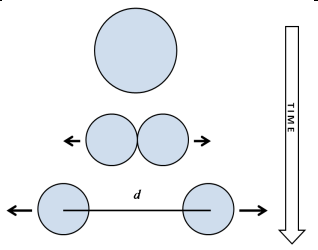
Схематическое описание ядерного деления в нашей модели.
Часть E. Реакции передачи
В современной физике энергетические свойства ядер и ядерные реакции описываются в единицах массы Например, если ядро (имеющее нулевую скорость), находится в возбуждённом состоянии с энергией выше основного состояния на величину \(E_{воз}\), его масca \(m=m_0+E_{воз}/c^2\), где \(m_0\) – масса покоящегося ядра в основном состоянии.
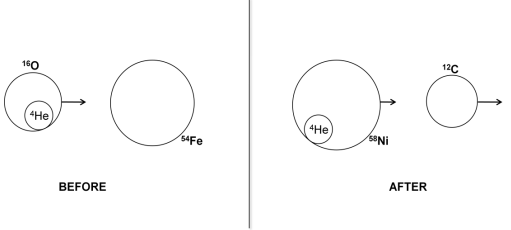
Ядерная реакция \(^{16}\mathrm O+^{54}\mathrm {Fe}\to ^{12}\mathrm C+^{58}\mathrm {Ni}\) – это пример так называемой реакции передачи, в которой некоторая часть одного ядра («кластер») переходит в другое ядро. В нашем примере передаваемая другому ядру часть – это \(^4 \mathrm{He}\) (\(\alpha\) - частица). Реакции передачи проходят с максимальной вероятностью, если скорость продукта реакции (в нашем случае \(^{12}\mathrm C\)) равна по модулю и направлению скорости налетающей частицы (в нашем случае \(^{16}\mathrm O\)). Мишень \(^{54}\mathrm{Fe}\) первоначально находится в состоянии покоя. Ядро \(^{58}\mathrm {Ni}\) оказывается в одном из возбуждённых состояний. Найдите энергию возбуждённого состояния (и выразите её в \(МэВ\)), если кинетическая энергия налетающего ядра \(^{16}\mathrm O\) равна \(50~МэВ\).
Ниже в таблице представлены массы покоя частиц в основном состоянии. \(1~а.е.м=1.6605\cdot 10^{-27}~кг\).
\(1\) \(M(^{16}\mathrm O)\) \(15.99491~а.е.м.\) \(2\) \(M(^{54}\mathrm {Fe})\) \(53.93962~а.е.м.\) \(3\) \(M(^{12}\mathrm C)\) \(12.00000~а.е.м.\) \(4\) \(M(^{58}\mathrm {Ni})\) \(57.93535~а.е.м.\) E2. Образовавшееся ядро \(^{58}\mathrm {Ni}\) (из E1), находящееся в возбуждённом состоянии, переходит в основное состояние, испуская при этом гамма-квант в направлении движения Рассмотрите реакцию в системе отсчёта, в которой ядро \(^{58}\mathrm {Ni}\) покоится, и найдите энергию отдачи \(E_{отд}\) (то есть, кинетическую энергию \(^{58}\mathrm {Ni}\) после испускания гамма кванта). Какова энергия гамма-кванта \(E_{\gamma}\) в этой системе отсчёта? Какова энергия гамма-кванта \(E_{дет}\) в лабораторной системе отсчёта (то есть какой будет энергия гамма-кванта, измеренная детектором, который покоится в лабораторной системе отсчёта и расположен в направлении движения ядра \(^{58}\mathrm {Ni}\))?
▶Показать разборСкрыть разбор
ОтветA1: \[f=\dfrac{\pi}{6}\]; A2: \[\rho_{m}\approx 3.40 \cdot 10^{17} \dfrac{\mathrm{~kg}}{\mathrm{~m}^{3}}\]\[\rho_{c} \approx 1.63 \cdot 10^{25}~\dfrac{\mathrm{C}}{\mathrm{m}^{3}}\]\[R\approx 1.06~\mathrm{fm} \cdot A^{1 / 3}\]; B1: \[E_{b}=\left(15.8 A-38.20 A^{2 / 3}+61.58 A^{1 / 3}-33.09\right) \mathrm{MeV}\]; C1: \[U_{c}=\frac{3 Z(Z-1) e^{2}}{20 \pi \varepsilon_{0} R}\]; C2: \[E_{b}=A a_{V}-3 f^{1 / 3} A^{2 / 3} a_{V}+6 f^{2 / 3} A^{1 / 3} a_{V}-4 f a_{V}-\frac{3 e^{2} f^{1 / 3}}{20 \pi \varepsilon_{0} r_{N}}\left(\frac{A^{5 / 3}}{4}-\frac{A^{2 / 3}}{2}\right)\]; D2: \[A \geq 227\]; E1: \[E_{x} =10.866 \mathrm{~MeV}\] \[E_{x} =10.8636 \mathrm{~MeV}\]
РешениеA1. In the SC-system, in each of \(8\) corners of a given cube there is one unit (atom, nucleon, etc.), but it is shared by \(8\) neighboring cubes - this gives a total of one nucleon per cube. If nucleons are touching, as we assume in our simplified model, then \(a=2 r_{N}\) is the cube edge length a. The volume of one nucleon is then
\[V_{N}=\frac{4}{3} r_{N}^{3} \pi=\frac{4}{3}\left(\frac{a}{2}\right)^{3} \pi=\frac{4 a^{3}}{3 \cdot 8} \pi=\frac{\pi}{6} a^{3} \qquad(1)\]
from which we obtain
\[f=\frac{V_{N}}{a^{3}}=\frac{\pi}{6} \approx 0.52\]
Ответ:
\[f=\dfrac{\pi}{6}\]
A2. The mass density of the nucleus is:
\[\rho_{m}=f \dfrac{m_{N}}{V_{N}}=0.52 \cdot \dfrac{1.67 \cdot 10^{-27}}{4 / 3 \cdot\left(0.85 \cdot 10^{-15}\right)^{3} \pi} \approx 3.40 \cdot 10^{17} \dfrac{\mathrm{~kg}}{\mathrm{~m}^{3}}.\]
Taking into account the approximation that the number of protons and neutrons is approximately equal, for charge density we get:\[\rho_{c}=\frac{f}{2} \frac{e}{V_{N}}=\frac{0.52}{2} \cdot \frac{1.6 \cdot 10^{-19}}{4 / 3 \cdot\left(0.85 \cdot 10^{-15}\right)^{3} \pi} \approx 1.63 \cdot 10^{25}~\frac{\mathrm{C}}{\mathrm{m}^{3}} \qquad(5)\]
The number of nucleons in a given nucleus is \(A\). The total volume occupied by the nucleus is:
\[V=\frac{A V_{N}}{f},\]
which gives the following relation between radii of nucleus and the number of nucleons:
\[R=r_{N}\left(\frac{A}{f}\right)^{1 / 3}=\frac{r_{N}}{f^{1 / 3}} A^{1 / 3}=\frac{0.85}{0.52^{1 / 3}} A^{1 / 3}\approx 1.06~\mathrm{fm} \cdot A^{1 / 3}.\]
The numerical constant (\(1.06~\mathrm{fm}\)) in the equation above will be denoted as \(r_{0}\) in the sequel.
Ответ:
\[\rho_{m}\approx 3.40 \cdot 10^{17} \dfrac{\mathrm{~kg}}{\mathrm{~m}^{3}}\]\[\rho_{c} \approx 1.63 \cdot 10^{25}~\dfrac{\mathrm{C}}{\mathrm{m}^{3}}\]\[R\approx 1.06~\mathrm{fm} \cdot A^{1 / 3}\]
B1. First one needs to estimate the number of surface nucleons. The surface nucleons are in a spherical shell of width \(2 r_{N}\) at the surface. The volume of this shell is
\(V_{\mathrm{surface }}=\frac{4}{3} R^{3} \pi-\frac{4}{3}\left(R-2 r_{N}\right)^{3} \pi= \qquad(8)\\=\frac{4}{3} R^{3} \pi-\frac{4}{3} R^{3} \pi+\frac{4}{3} \pi 3 R^{2} 2 r_{N}-\frac{4}{3} \pi 3 R 4 r_{N}^{2}+\frac{4}{3} \pi 8 r_{N}^{3} =\\=8 \pi R r_{N}\left(R-2 r_{N}\right)+\frac{4}{3} \pi 8 r_{N}^{3}= \\ =8 \pi\left(R^{2} r_{N}-2 R r_{N}^{2}+\frac{4}{3} r_{N}^{3}\right)\)
The number of surface nucleons is:
\(A_{\mathrm{surface }}=f \dfrac{V_{\mathrm{surface }}}{V_{N}}=f \dfrac{8 \pi\left(R^{2} r_{N}-2 R r_{N}^{2}+\frac{4}{3} r_{N}^{3}\right)}{\frac{4}{3} r_{N}^{3} \pi}=\) \(=f\cdot 6\left(\left(\dfrac{R}{r_{N}}\right)^{2}-2\left(\dfrac{R}{r_{N}}\right)+\dfrac{4}{3}\right)=\) \(=f \cdot 6\left(\left(\dfrac{A}{f}\right)^{2 / 3}-2\left(\dfrac{A}{f}\right)^{1 / 3}+\dfrac{4}{3}\right)=\) \(=6 f^{1 / 3} A^{2 / 3}-12 f^{2 / 3} A^{1 / 3}+8 f=\) \(=6^{2 / 3} \pi^{1 / 3} A^{2 / 3}-2 \cdot 6^{1 / 3} \pi^{2 / 3} A^{1 / 3}+\frac{4}{3} \pi\)
\(A_{\mathrm{surface }}\approx 4.84 A^{2 / 3}-7.80 A^{1 / 3}+4.19 . \qquad(9)\)
The binding energy is now:
\(E_{b}=\left(A-A_{\text {surface }}\right) a_{V}+A_{\text {surface }} \frac{a_{V}}{2}= \\ =A a_{V}-A_{\text {surface }} \frac{a_{V}}{2}= \\ =A a_{V}-\left(3 f^{1 / 3} A^{2 / 3}-6 f^{2 / 3} A^{1 / 3}+4 f\right) a_{V}= \\ =A a_{V}-3 f^{1 / 3} A^{2 / 3} a_{V}+6 f^{2 / 3} A^{1 / 3} a_{V}-4 f a_{V}= \\ =\left(15.8 A-38.20 A^{2 / 3}+61.58 A^{1 / 3}-33.09\right) \mathrm{MeV}\)
Ответ:
\[E_{b}=\left(15.8 A-38.20 A^{2 / 3}+61.58 A^{1 / 3}-33.09\right) \mathrm{MeV}\]
C1. Replacing \(Q_{0}\) with \(Z e\) gives the electrostatic energy of the nucleus as:\[U_{c}=\frac{3(Z e)^{2}}{20 \pi \varepsilon_{0} R}=\frac{3 Z^{2} e^{2}}{20 \pi \varepsilon_{0} R} \qquad(12)\]
The fact that each proton is not acting upon itself is taken into account by replacing \(Z^{2}\) with \(Z(Z-1)\):\[U_{c}=\frac{3 Z(Z-1) e^{2}}{20 \pi \varepsilon_{0} R} \qquad(13)\]
Ответ:
\[U_{c}=\frac{3 Z(Z-1) e^{2}}{20 \pi \varepsilon_{0} R}\]
C2. In the formula for the electrostatic energy we should replace \(R\) with \(r_{N} f^{-1 / 3} A^{1 / 3}\) to obtain
\[\Delta E_{b}=-\frac{3 e^{2} f^{1 / 3}}{20 \pi \varepsilon_{0} r_{N}} \frac{Z(Z-1)}{A^{1 / 3}}=-\frac{Z(Z-1)}{A^{1 / 3}} \cdot 1.31 \times 10^{-13} \mathrm{ J} \qquad(14)\\ =-\frac{Z(Z-1)}{A^{1 / 3}} \cdot 0.815 \mathrm{ MeV} \approx-0.204 \mathrm{ A}^{5 / 3} \mathrm{ MeV}+0.409 \mathrm{ A}^{2 / 3} \mathrm{ MeV}\]
where \(Z \approx A / 2\) has been used. The Coulomb repulsion reduces the binding energy, hence the negative sign before the first (main) term. The complete formula for binding energy now gives:
\[E_{b}=A a_{V}-3 f^{1 / 3} A^{2 / 3} a_{V}+6 f^{2 / 3} A^{1 / 3} a_{V}-4 f a_{V}-\frac{3 e^{2} f^{1 / 3}}{20 \pi \varepsilon_{0} r_{N}}\left(\frac{A^{5 / 3}}{4}-\frac{A^{2 / 3}}{2}\right) \qquad(15)\]
Ответ:
\[E_{b}=A a_{V}-3 f^{1 / 3} A^{2 / 3} a_{V}+6 f^{2 / 3} A^{1 / 3} a_{V}-4 f a_{V}-\frac{3 e^{2} f^{1 / 3}}{20 \pi \varepsilon_{0} r_{N}}\left(\frac{A^{5 / 3}}{4}-\frac{A^{2 / 3}}{2}\right)\]
D1. The kinetic energy comes from the difference of binding energies (2 small nuclei - the original large one) and the Coulomb energy between two smaller nuclei (with \(Z / 2=A / 4\) nucleons each):\[E_{k i n}(d)=2 E_{b}\left(\frac{A}{2}\right)-E_{b}(A)-\frac{1}{4 \pi \varepsilon_{0}} \frac{A^{2} e^{2}}{4 \cdot 4 \cdot d}= \qquad(16)\\ =-3 f^{1 / 3} A^{2 / 3} a_{V}\left(2^{1 / 3}-1\right)+6 f^{2 / 3} A^{1 / 3} a_{V}\left(2^{2 / 3}-1\right)- \\ -4 f a_{V}-\frac{3 e^{2} f^{1 / 3}}{20 \pi \varepsilon_{0} r_{N}}\left[\frac{A^{5 / 3}}{4}\left(2^{-2 / 3}-1\right)-\frac{A^{2 / 3}}{2}\left(2^{1 / 3}-1\right)\right] -\\ -\frac{1}{4 \pi \varepsilon_{0}} \frac{A^{2} e^{2}}{16 d}\] (notice that the first term, \(A a_{v}\), cancels out).
Ответ:
\[E_\mathrm{k i n}(d) =-3 f^{1 / 3} A^{2 / 3} a_{V}\left(2^{1 / 3}-1\right)+6 f^{2 / 3} A^{1 / 3} a_{V}\left(2^{2 / 3}-1\right)- \\ -4 f a_{V}-\dfrac{3 e^{2} f^{1 / 3}}{20 \pi \varepsilon_{0} r_{N}}\left[\dfrac{A^{5 / 3}}{4}\left(2^{-2 / 3}-1\right)-\dfrac{A^{2 / 3}}{2}\left(2^{1 / 3}-1\right)\right] -\dfrac{1}{4 \pi \varepsilon_{0}} \dfrac{A^{2} e^{2}}{16 d}\]
D2. The kinetic energy when \(d=2 R(A / 2)\) is given with:
\(E_{\text{kin}}=2 E_{b}\left(\dfrac{A}{2}\right)-E_{b}(A)-\dfrac{1}{4 \pi \varepsilon_{0}} \dfrac{2^{1 / 3} A^{2} e^{2}}{16 \cdot 2 r_{N} A^{1 / 3} f^{-1 / 3}}= \qquad(17)\\ =-3 f^{1 / 3} A^{2 / 3} a_{V}\left(2^{1 / 3}-1\right)+6 f^{2 / 3} A^{1 / 3} a_{V}\left(2^{2 / 3}-1\right) \\ -4 f a_{V}-\dfrac{e^{2} f^{1 / 3}}{\pi \varepsilon_{0} r_{N}}\left[\dfrac{3}{80}\left(2^{-2 / 3}-1\right)+\dfrac{2^{1 / 3}}{128}\right] A^{5 / 3}-\dfrac{e^{2} f^{1 / 3}}{\pi \varepsilon_{0} r_{N}}\left[\dfrac{3}{40}\left(2^{1 / 3}-1\right)\right] A^{2 / 3}= \\ =\left(0.02203 A^{5 / 3}-10.0365 A^{2 / 3}+36.175 A^{1 / 3}-33.091\right) \mathrm{MeV}\)
Numerically one gets:
\(A\) 100 150 200 250 \(E_{\text{kin}},~\mathrm{MeV}\) -33.95 -30.93 -14.10 +15.06 In our model, fission is possible when \(E_{\text {kin }}(d=2 R(A / 2)) \geq 0\). From the numerical evaluations given above, one sees that this happens approximately halfway between \(A=200\) and \(A=250\) – a rough estimate would be \(A \approx 225\). Precise numerical evaluation of the equation:
\[E_{k i n}=\left(0.02203 A^{5 / 3}-10.0365 A^{2 / 3}+36.175 A^{1 / 3}-33.091\right) \mathrm{MeV} \geq 0 \qquad(18)\]
gives that for \(A \geq 227\) fission is possible.
Ответ:
\[A \geq 227\]
E1. This part can be solved by using either non-relativistic or relativistic kinematics.
Non-relativistic solution
First one has to find the amount of mass transferred to energy in the reaction (or the energy equivalent, so-called Q-value):
\[\begin{align*}\Delta m&=(\text { total mass })_{\text {after reaction }}-(\text { total mass })_{\text {before reaction }}=\\&=(57.93535+12.00000)~\mathrm{a.m.u.}-(53.93962+15.99491)~\mathrm{a.m.u.}=\\&=0.00082~\mathrm{a.m.u.} =1.3616 \cdot 10^{-30} \mathrm{~kg}.\qquad(19)\end{align*}\]
Using the Einstein formula for equivalence of mass and energy, we get:
\(Q =(\text { total kinetic energy })_{\text {after reaction }}-(\text { total kinetic energy })_{\text {before reaction }}= \qquad(20)\\ =-\Delta m \cdot c^{2} =(-1.3616 \cdot 10^{-30} \cdot 299792458^{2})\mathrm{ J}=-1.2237 \cdot 10^{-13} \mathrm{ J}\)
Taking into account that \(1~\mathrm{MeV}\) is equal to \(1.602 \cdot 10^{-13} \mathrm{~J}\), we get:\[Q=(-1.2237 \cdot 10^{-13} / 1.602 \cdot 10^{-13})~\mathrm{MeV}=-0.761~\mathrm{MeV} \qquad(21)\]
This exercise is now solved using the laws of conservation of energy and momentum. The latter gives (we are interested only for the case when \({ }^{12} \mathrm{C}\) and \({ }^{16} \mathrm{O}\) are having the same direction so we don't need to use vectors):\[m\left({ }^{16} \mathrm{O}\right) v\left({ }^{16} \mathrm{O}\right)=m\left({ }^{12} \mathrm{C}\right) v\left({ }^{12} \mathrm{C}\right)+m\left({ }^{58} \mathrm{Ni}\right) v\left({ }^{58} \mathrm{Ni}\right) \qquad(22)\]
while the conservation of energy gives:\[E_{k}\left({ }^{16} \mathrm{O}\right)+Q=E_{k}\left({ }^{12} \mathrm{C}\right)+E_{k}\left({ }^{58} \mathrm{Ni}\right)+E_{x}\left({ }^{58} \mathrm{Ni}\right) \qquad(23)\]
where \(E_{x}\left({ }^{58} \mathrm{Ni}\right)\) is the excitation energy of \({ }^{58} \mathrm{Ni}\), and \(Q\) is calculated in the first part of this task.
But since \({ }^{12} \mathrm{C}\) and \({ }^{16} \mathrm{O}\) have the same velocity, conservation of momentum reduced to: \[\left[m\left({ }^{16} \mathrm{O}\right)-m\left({ }^{12} \mathrm{C}\right)\right] v\left({ }^{16} \mathrm{O}\right)=m\left({ }^{58} \mathrm{Ni}\right) v\left({ }^{58} \mathrm{Ni}\right) \qquad(24)\]
Now we can easily find the kinetic energy of \({ }^{58} \mathrm{Ni}\):\[E_{k}\left({ }^{58} \mathrm{Ni}\right) =\frac{m\left({ }^{58} \mathrm{Ni}\right) v^{2}\left({ }^{58} \mathrm{Ni}\right)}{2}=\frac{\left[m\left({ }^{58} \mathrm{Ni}\right) v\left({ }^{58} \mathrm{Ni}\right)\right]^{2}}{2 m\left({ }^{58} \mathrm{Ni}\right)}= \qquad(25)\\ =\frac{\left.\left[m\left({ }^{16} \mathrm{O}\right)-m\left({ }^{12} \mathrm{C}\right)\right] v\left({ }^{16} \mathrm{O}\right)\right]^{2}}{2 m\left({ }^{58} \mathrm{Ni}\right)}=E_{k}\left({ }^{16} \mathrm{O}\right) \frac{\left[m\left({ }^{16} \mathrm{O}\right)-m\left({ }^{12} \mathrm{C}\right)\right]^{2}}{m\left({ }^{58} \mathrm{Ni}\right) m\left({ }^{16} \mathrm{O}\right)}\]
and finally the excitation energy of \({ }^{58} \mathrm{Ni}\):\[E_{x}\left({ }^{58} \mathrm{Ni}\right)=E_{k}\left({ }^{16} \mathrm{O}\right)+Q-E_{k}\left({ }^{12} \mathrm{C}\right)-E_{k}\left({ }^{58} \mathrm{Ni}\right)= \qquad(26)\\ =E_{k}\left({ }^{16} \mathrm{O}\right)+Q-\frac{m\left({ }^{12} \mathrm{C}\right) v^{2}\left({ }^{16} \mathrm{O}\right)}{2}-E_{k}\left({ }^{16} \mathrm{O}\right) \frac{\left[m\left({ }^{16} \mathrm{O}\right)-m\left({ }^{12} \mathrm{C}\right)\right]^{2}}{m\left({ }^{58} \mathrm{Ni}\right) m\left({ }^{16} \mathrm{O}\right)}= \\ =Q+E_{k}\left({ }^{16} \mathrm{O}\right)-E_{k}\left({ }^{16} \mathrm{O}\right) \cdot \frac{m\left({ }^{12} \mathrm{C}\right)}{m\left({ }^{16} \mathrm{O}\right)}-E_{k}\left({ }^{16} \mathrm{O}\right) \frac{\left[m\left({ }^{16} \mathrm{O}\right)-m\left({ }^{12} \mathrm{C}\right)\right]^{2}}{m\left({ }^{58} \mathrm{Ni}\right) m\left({ }^{16} \mathrm{O}\right)}= \\ =Q+E_{k}\left({ }^{16} \mathrm{O}\right)\left[1-\frac{m\left({ }^{12} \mathrm{C}\right)}{m\left({ }^{16} \mathrm{O}\right)}-\frac{\left.\left[m\left({ }^{16} \mathrm{O}\right)-m\left({ }^{12} \mathrm{C}\right)\right]^{2}\right]}{m\left({ }^{58} \mathrm{Ni}\right) m\left({ }^{16} \mathrm{O}\right)}\right]= \\ =Q+E_{k}\left({ }^{16} \mathrm{O}\right) \frac{\left[m\left({ }^{16} \mathrm{O}\right)-m\left({ }^{12} \mathrm{C}\right)\right] \cdot\left[m\left({ }^{58} \mathrm{Ni}\right)-m\left({ }^{16} \mathrm{O}\right)+m\left({ }^{12} \mathrm{C}\right)\right]}{m\left({ }^{58} \mathrm{Ni}\right) m\left({ }^{16} \mathrm{O}\right)}\]
Note that the first bracket in numerator is approximately equal to the mass of transferred particle (the \({ }^{4} \mathrm{He}\) nucleus), while the second one is approximately equal to the mass of target nucleus \({ }^{54} \mathrm{Fe}\). Inserting the numbers we get:\[E_{x}\left({ }^{58} \mathrm{Ni}\right) =\left(-0.761+50 \cdot \frac{(15.99491-12 .)(57.93535-15.99491+12 .)}{57.93535 \cdot 15.99491}\right) \mathrm{ MeV}= \qquad(27)\\ =10.866 \mathrm{ MeV}\]
Ответ:
\[E_{x} =10.866 \mathrm{~MeV}\]
Relativistic solution
In the relativistic version, solution is found starting from the following pair of equations (the first one is the law of conservation of energy and the second one the law of conservation of momentum):\[m\left({ }^{54} \mathrm{Fe}\right) \cdot c^{2}+\frac{m\left({ }^{16} \mathrm{O}\right) \cdot c^{2}}{\sqrt{1-v^{2}\left({ }^{16} \mathrm{O}\right) / c^{2}}}=\frac{m\left({ }^{12} \mathrm{C}\right) \cdot c^{2}}{\sqrt{1-v^{2}\left({ }^{12} \mathrm{C}\right) / c^{2}}}+\frac{m^{*}\left({ }^{58} \mathrm{Ni}\right) \cdot c^{2}}{\sqrt{1-v^{2}\left({ }^{58} \mathrm{Ni}\right) / c^{2}}} \qquad(28)\]\[\frac{m\left({ }^{16} \mathrm{O}\right) \cdot v\left({ }^{16} \mathrm{O}\right)}{\sqrt{1-v^{2}\left({ }^{16} \mathrm{O}\right) / c^{2}}}=\frac{m\left({ }^{12} \mathrm{C}\right) \cdot v\left({ }^{12} \mathrm{C}\right)}{\sqrt{1-v^{2}\left({ }^{12} \mathrm{C}\right) / c^{2}}}+\frac{m^{*}\left({ }^{58} \mathrm{Ni}\right) \cdot v\left({ }^{58} \mathrm{Ni}\right)}{\sqrt{1-v^{2}\left({ }^{58} \mathrm{Ni}\right) / c^{2}}}\]All the masses in the equations are the rest masses; the \({ }^{58} \mathrm{Ni}\) is NOT in its ground-state, but in one of its excited states (having the mass denoted with \(m^{*}\)). Since \({ }^{12} \mathrm{C}\) and \({ }^{16} \mathrm{O}\) have the same velocity, this set of equations reduces to:\[\begin{array}{l}m\left({ }^{54} \mathrm{Fe}\right)+\dfrac{m\left({ }^{16} \mathrm{O}\right)-m\left({ }^{12} \mathrm{C}\right)}{\sqrt{1-v^{2}\left({ }^{16} \mathrm{O}\right) / c^{2}}}=\dfrac{m^{*}\left({ }^{58} \mathrm{Ni}\right)}{\sqrt{1-v^{2}\left({ }^{58} \mathrm{Ni}\right) / c^{2}}} \qquad(29)\\ \dfrac{\left(m\left({ }^{16} \mathrm{O}\right)-m\left({ }^{12} \mathrm{C}\right)\right) \cdot v\left({ }^{16} \mathrm{O}\right)}{\sqrt{1-v^{2}\left({ }^{16} \mathrm{O}\right) / c^{2}}}=\dfrac{m^{*}\left({ }^{58} \mathrm{Ni}\right) \cdot v\left({ }^{58} \mathrm{Ni}\right)}{\sqrt{1-v^{2}\left({ }^{58} \mathrm{Ni}\right) / c^{2}}}\end{array}\]
Dividing the second equation with the first one gives:
\[v\left({ }^{58} \mathrm{Ni}\right)=\frac{\left(m\left({ }^{16} \mathrm{O}\right)-m\left({ }^{12} \mathrm{C}\right)\right) \cdot v\left({ }^{16} \mathrm{O}\right)}{\left(m\left({ }^{16} \mathrm{O}\right)-m\left({ }^{12} \mathrm{C}\right)\right)+m\left({ }^{54} \mathrm{Fe}\right) \sqrt{1-v^{2}\left({ }^{16} \mathrm{O}\right) / c^{2}}} \qquad(30)\]
The velocity of projectile can be calculated from its energy:
\[\begin{align*} & E_{k i n}\left({ }^{16} \mathrm{O}\right)=\frac{m\left({ }^{16} \mathrm{O}\right) \cdot c^{2}}{\sqrt{1-v^{2}\left({ }^{16} \mathrm{O}\right) / c^{2}}}-m\left({ }^{16} \mathrm{O}\right) \cdot c^{2} \qquad(31)\\ & \sqrt{1-v^{2}\left({ }^{16} \mathrm{O}\right) / c^{2}}=\frac{m\left({ }^{16} \mathrm{O}\right) \cdot c^{2}}{E_{k i n}\left({ }^{16} \mathrm{O}\right)+m\left({ }^{16} \mathrm{O}\right) \cdot c^{2}} \\ & v^{2}\left({ }^{16} \mathrm{O}\right) / c^{2}=1-\left(\frac{m\left({ }^{16} \mathrm{O}\right) \cdot c^{2}}{E_{k i n}\left({ }^{16} \mathrm{O}\right)+m\left({ }^{16} \mathrm{O}\right) \cdot c^{2}}\right)^{2} \\ & v\left({ }^{16} \mathrm{O}\right)=\sqrt{1-\left(\frac{m\left({ }^{16} \mathrm{O}\right) \cdot c^{2}}{E_{k i n}\left({ }^{16} \mathrm{O}\right)+m\left({ }^{16} \mathrm{O}\right) \cdot c^{2}}\right)^{2}} \cdot c \end{align*}\]
For the given numbers we get:
\[\begin{align*} v\left({ }^{16} \mathrm{O}\right) & =\sqrt{1-\left(\frac{15.99491 \cdot 1.6605 \cdot 10^{-27} \cdot\left(2.9979 \cdot 10^{8}\right)^{2}}{50 \cdot 1.602 \cdot 10^{-13}+15.99491 \cdot\left(2.9979 \cdot 10^{8}\right)^{2}}\right)^{2}} \cdot c= \qquad(32)\\ & =\sqrt{1-0.99666^{2}} \cdot c=0.08172 \cdot c=2.4498 \cdot 10^{7} \mathrm{ km} / \mathrm{s} \end{align*}\]
Now we can calculate:
\[v\left({ }^{58} \mathrm{Ni}\right)=\frac{(15.99491-12.0) \cdot 2.4498 \cdot 10^{7} \mathrm{ km} / \mathrm{s}}{(15.99491-12.0)+53.93962 \sqrt{1-0.08172^{2}}}=1.6946 \cdot 10^{6} \mathrm{ km} / \mathrm{s} \qquad(33)\]
The mass of \({ }^{58} \mathrm{Ni}\) in its excited state is then:
\[m^{*}\left({ }^{58} \mathrm{Ni}\right) =\left(m\left({ }^{16} \mathrm{O}\right)-m\left({ }^{12} \mathrm{C}\right)\right) \frac{\sqrt{1-v^{2}\left({ }^{58} \mathrm{Ni}\right) / c^{2}}}{\sqrt{1-v^{2}\left({ }^{16} \mathrm{O}\right) / c^{2}}} \cdot \frac{v\left({ }^{16} \mathrm{O}\right)}{v\left({ }^{58} \mathrm{Ni}\right)}= \\ =(15.99491-12.0) \frac{\sqrt{1-\left(1.6945 \cdot 10^{6} / 2.9979 \cdot 10^{8}\right)^{2}}}{\sqrt{1-0.08172^{2}}} \cdot \frac{2.4498 \cdot 10^{7}}{1.6945 \cdot 10^{6}} \text { a.m.u. } \\ =57.9470 \text { a.m.u. }\qquad(34)\]The excitation energy of \({ }^{58} \mathrm{Ni}\) is then:
\[\begin{align*} E_{x} & =\left[m^{*}\left({ }^{58} \mathrm{Ni}\right)-m\left({ }^{58} \mathrm{Ni}\right)\right] \cdot c^{2}=(57.9470-57.93535) \cdot 1.6605 \cdot 10^{-27}\left(2.9979 \cdot 10^{8}\right)^{2}= \qquad(35)\\ & =2.00722 \cdot 10^{-12} / 1.602 \cdot 10^{-13} \mathrm{ MeV} / \mathrm{J}=10.8636 \mathrm{ MeV} \end{align*}\]The relativistic and non-relativistic results are equal within \(2~ \mathrm{keV}\) so both can be considered as correct – we can conclude that at the given beam energy, relativistic effects are not important.
Ответ:
\[E_{x} =10.8636 \mathrm{~MeV}\]
E2. For gamma-emission from the static nucleus, laws of conservation of energy and momentum give:\[E_{x}\left({ }^{58} \mathrm{Ni}\right)=E_{\gamma}+E_{\text {recoil }} \\ p_{\gamma}=p_{\text {recoil }}\] Gamma-ray and recoiled nucleus have, of course, opposite directions. For gamma-ray (photon), energy and momentum are related as: \[E_{\gamma}=p_{\gamma} \cdot c \qquad(37)\] In task E1 we have seen that the nucleus motion in this energy range is not relativistic, so we have: \[E_{\text {recoil }}=\frac{p_{\text {recoil }}^{2}}{2 m\left({ }^{58} \mathrm{Ni}\right)}=\frac{p_{\gamma}^{2}}{2 m\left({ }^{58} \mathrm{Ni}\right)}=\frac{E_{\gamma}^{2}}{2 m\left({ }^{58} \mathrm{Ni}\right) \cdot c^{2}} \qquad(38)\] Inserting this into law of energy conservation Eq. (36), we get:\[E_{x}\left({ }^{58} \mathrm{Ni}\right)=E_{\gamma}+E_{\text {recoil }}=E_{\gamma}+\frac{E_{\gamma}^{2}}{2 m\left({ }^{58} \mathrm{Ni}\right) \cdot c^{2}} \qquad(39)\]This reduces to the quadratic equation:\[E_{\gamma}^{2}+2 m\left({ }^{58} \mathrm{Ni}\right) c^{2} \cdot E_{\gamma}+2 m\left({ }^{58} \mathrm{Ni}\right) c^{2} E_{x}\left({ }^{58} \mathrm{Ni}\right)=0 \qquad(40)\]which gives the following solution:\[\begin{align*} E_{\gamma} & =\frac{-2 m\left({ }^{58} \mathrm{Ni}\right) c^{2}+\sqrt{4\left(m\left({ }^{58} \mathrm{Ni}\right) c^{2}\right)^{2}+8 m\left({ }^{58} \mathrm{Ni}\right) c^{2} E_{x}\left({ }^{58} \mathrm{Ni}\right)}}{2}= \qquad(41)\\ & =\sqrt{\left(m\left({ }^{58} \mathrm{Ni}\right) c^{2}\right)^{2}+2 m\left({ }^{58} \mathrm{Ni}\right) c^{2} E_{x}\left({ }^{58} \mathrm{Ni}\right)}-m\left({ }^{58} \mathrm{Ni}\right) c^{2} \end{align*}\]Inserting numbers gives:\[E_{\gamma}=10.8633 \mathrm{ MeV} \qquad(42)\]The equation (37) can also be reduced to an approximate equation before inserting numbers:\[E_{\gamma}=E_{x}\left(1-\frac{E_{x}}{2 m\left({ }^{58} \mathrm{Ni}\right) c^{2}}\right)=10.8633 \mathrm{ MeV} \qquad(43)\]The recoil energy is now easily found as:\[E_{\text {recoil }}=E_{x}\left({ }^{58} \mathrm{Ni}\right)-E_{\gamma}=1.1 \mathrm{ keV} \qquad(44)\]Due to the fact that nucleus emitting gamma-ray \(\left({ }^{58} \mathrm{Ni}\right)\) is moving with the high velocity, the energy of gamma ray will be changed because of the Doppler effect. The relativistic Doppler effect (when source is moving towards observer/detector) is given with this formula:\[f_{\text {detector }}=f_{\gamma, \text { emitted }} \sqrt{\frac{1+\beta}{1-\beta}} \qquad(45)\]and since there is a simple relation between photon energy and frequency (\(E=h f\)), we get the similar expression for energy:\[E_{\text {detector }}=E_{\gamma, \text { emitted }} \sqrt{\frac{1+\beta}{1-\beta}} \qquad(46)\]where \(\beta=v / c\) and \(v\) is the velocity of emitter (the \({ }^{58} \mathrm{Ni}\) nucleus). Taking the calculated value of the \({ }^{58} \mathrm{Ni}\) velocity (equation \(29\)) we get:\[E_{\text {detector }}=E_{\gamma, \text { emitted }} \sqrt{\frac{1+\beta}{1-\beta}}=10.863 \sqrt{\frac{1+0.00565}{1-0.00565}}=10.925 \mathrm{MeV} \qquad(47)\]
Ответ:
\[E_{\text {detector }}=10.925 \mathrm{~MeV}\]
Перевод: pho.rs.
Похожие задачи
- Протоны и дейтроны на льду МОШ 2006/07, 11 кл.
- Конструирование ядерного реактора IPhO 2014/15, 11 кл.
- В поисках нейтрино IPhO 2017/18, 11 кл.